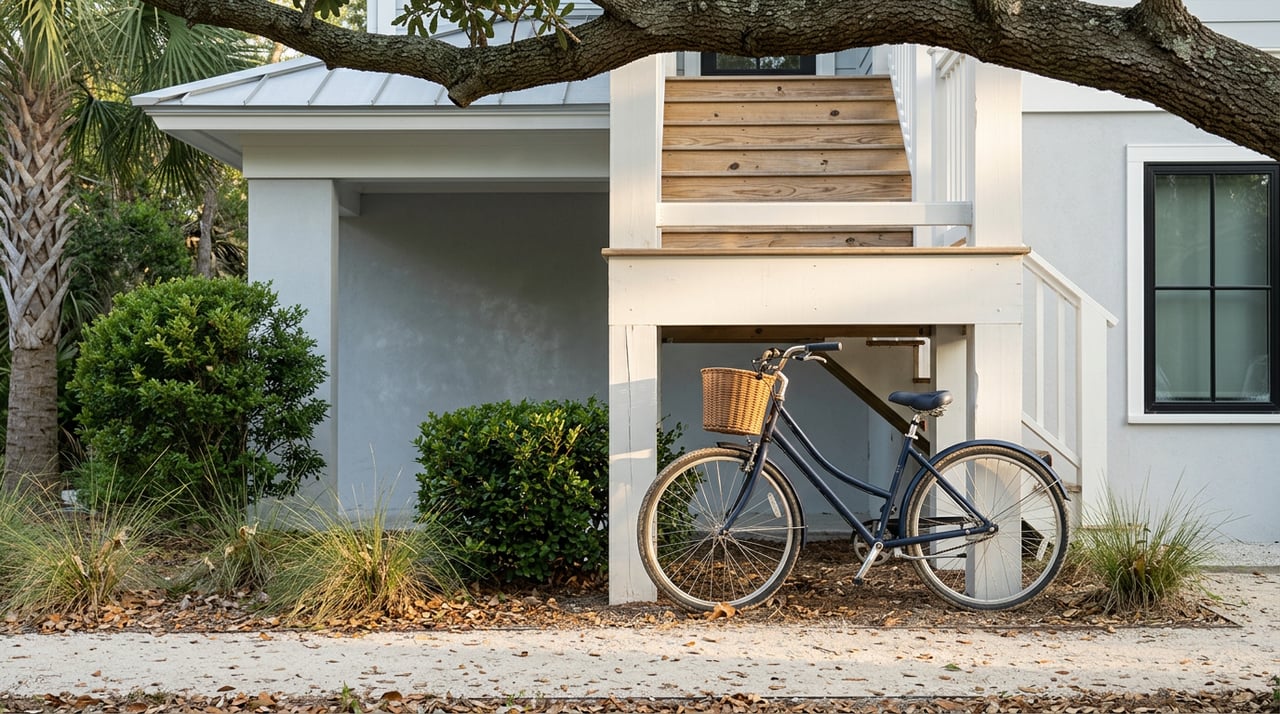
Most people who look at a home on Bald Head Island fall in love with the absence of cars before they fall in love with the house. No engines idling in driveways, no exhaust drifting through the maritime forest, just golf carts humming along at 18 miles per hour. It reads as charm. What it actually is, for anyone who owns property there, is a dependency on a single privately held transportation system that just changed hands for $56 million, and on a Village permitting structure that rewrote its own rulebook twice in the past year.
That is the piece buyers tend to miss. The island's homeowners associations get plenty of attention during due diligence. The ferry and barge system, the thing that determines whether your furniture, your contractor, or you personally can get on or off the island at all, gets treated like a footnote. It shouldn't be. It functions less like a quirky amenity and more like an HOA with teeth: it sets the schedule, it sets the price, and lately it has been the subject of a fight the Village itself was willing to have in public.
A System That Changed Owners While No One Was Watching
The ferry and barge that serve Bald Head Island, along with the mainland parking area at Deep Point Marina, were sold in a transaction valued at $56 million to SharpVue Capital. The Village of Bald Head Island opposed the sale, citing concerns about public convenience and necessity and the risk that a private buyer might not prioritize the island's access needs the way a long-term island operator would. The deal proceeded anyway, under the oversight of the North Carolina Utilities Commission, which regulates rates for what is legally a public utility even though it is privately owned.
That distinction matters more than it sounds. A homeowner's association answers to its members. A public utility answers to a state commission, and the commission's job is to balance fair access against reasonable rates for the operator, not to guarantee the lowest possible cost or the most convenient schedule for residents. If you are underwriting a purchase on the assumption that ferry fares and barge availability will hold steady simply because they always have, you're underwriting against a system that just proved it can be bought and sold like any other asset.
What Actually Sold, and What the Village Still Controls
It helps to separate the two authorities that govern life on the island, because they are not the same one. SharpVue Capital now owns the ferry, the barge, and the mainland parking that feeds both. The Village of Bald Head Island, meanwhile, still writes and enforces the rules for what happens once you're on land: golf cart registration, road ordinances, contractor parking, and the permitting system for any gas-powered vehicle that comes over on the barge.
That split is worth internalizing before you make an offer. The cost and reliability of getting to the island sits with a private company under state rate regulation. The cost and rules of operating once you're there sit with a local government that has been actively rebuilding its own systems. Both have moved in the past year. Neither is finished moving.
The Golf Cart Paperwork Now Follows You Home
In December 2025, the Village rolled out a new online registration system for golf carts and electric vehicles, replacing the old process of picking up a sticker at the Department of Public Safety. Owners now log in with a PIN, verify insurance and cart details, and pay online. Enforcement of the new registrations began July 1, 2026, and as of June 29, 2026 about 91 percent of existing carts on the island had been renewed under the new system, meaning roughly one in ten had not.
For a buyer, this is not background trivia. A golf cart is not automatically part of the deed the way a built-in appliance is. If a seller's cart stays with the house, the Village's system needs to reflect that change of ownership, and the seller is expected to mark the old registration as sold rather than let it sit active under their name. If you're planning to bring your own cart over on the ferry instead, it needs its own registration before it touches Village streets, gas-powered carts included, though only electric carts are permitted at all on Village roads.
Here is what the current fee structure actually looks like, pulled from the Village's fiscal year 2025-2026 schedule:
| Item | Rate |
|---|---|
| Golf cart registration | $30 per year |
| Golf cart parking (monthly) | $60 |
| Golf cart parking (annual) | $600 |
| ICE (gas vehicle) parking, monthly | $120 |
| ICE (gas vehicle) parking, annual | $1,200 |
| Contractor storage unit rental, monthly | $800 |
None of these numbers are large in isolation. Together, they describe a fee structure that is less than a year old and still being enforced into compliance. A system that just went from paper stickers to online PINs, with 9 percent of owners still catching up months after the deadline, is not a mature, static cost. It is one still finding its final shape, and the direction it has moved so far is toward more registration, more fees, and more enforcement, not less.
Everything Heavy Moves on Barge Time
The golf cart system governs daily movement. The barge governs everything bigger: appliances, furniture, construction materials, and any gas-powered vehicle that needs to be on the island temporarily. It runs Monday through Friday, with the last departure from the island at 3 p.m., and it carries no passengers at all, only drivers, permitted aboard as crew under the vessel's Coast Guard certificate. Reservations are required in both directions, and the operator recommends booking at least two weeks ahead, especially if you need a same-day return. Cancel with less than 24 hours' notice and you're charged the full rate anyway.
Any gas-powered vehicle that comes over on the barge needs an ICE permit to use Village-maintained roads, along with restrictions on hours of operation, vehicle and trailer size, and which parts of the island it can enter at all. This is the system a contractor's truck, a moving company's vehicle, or a delivery van has to work within, and it is worth asking about before you sign a contract with a firm that hasn't done it before.
For a buyer closing on a home that needs work, this changes the math on timing. On the mainland, a kitchen remodel starts when the contractor has an opening. On Bald Head Island, it starts when the barge has an opening, the ICE permit is approved, and the contractor's parking arrangement is settled, whether that's a monthly ICE space or a longer-term contractor storage unit. Build two to three weeks of lead time into any renovation or move that depends on getting materials or a gas-powered vehicle onto the island, not because the island is disorganized, but because the barge schedule and permit approvals are the actual bottleneck, not your contractor's calendar.
What This Means When You Compare Two Otherwise Similar Homes
Here is the part that should change how you weigh a purchase decision. Because the transportation system and the permitting rules around it are both less than a year into their current form, today's fees and schedules are a starting point, not a settled baseline. A private owner now controls the ferry and barge under state rate regulation that balances the operator's interests against the public's. A local government is still working new golf cart and ICE permit systems into full compliance. Both of those facts point the same direction: expect adjustment, not permanence.
That reframes what actually distinguishes two comparable listings. A home near the marina and barge landing carries a practical logistics advantage for anyone planning a renovation or a full furniture move, not just a scenic one. A seller whose existing golf cart is already registered and current saves the buyer a step most people don't think to ask about until after closing. And a buyer working with a contractor who already understands barge scheduling and ICE permitting avoids weeks of delay that have nothing to do with the quality of the work itself.
Quick Answers for Buyers
Does a golf cart transfer automatically when a home sells? No. The Village's registration is tied to an owner's name and address, not the property. Sellers mark a sold cart as such in the system, and buyers register it under their own name before operating it.
Can I bring a personal gas-powered vehicle over for moving day? Only with an ICE permit, and only within the Village's restricted hours, vehicle size limits, and approved road areas. The barge is the only way to get it there, and it carries no passengers, only the driver.
How far ahead should I book barge transport for a renovation or move? At least two weeks is the standard recommendation, longer during summer. The barge runs weekdays only, with a 3 p.m. last departure, and cancellations inside 24 hours are charged in full.
If you're weighing a purchase on Bald Head Island and want to understand how these logistics actually play out against a specific property, from barge distance to a seller's cart registration status, David Wray can walk through it with you directly. Request a private consultation with David & Suzanne Wray before you write an offer, not after.
